Very simply, MySQL is an open-source relational database management system (RDBMS) that helps you store, organize, and query information securely for web applications, enterprise software, and robust data analytics. MySQL empowers you to manage massive concurrent workloads and scale structured data far more reliably than flat files or spreadsheet applications.
The Problem with Static Data Storage
Flat files, spreadsheets, and ad-hoc file systems are terrific tools for maintaining small, isolated sets of records. They are intuitive to initialize, populate with rows, and filter on an individual desktop.
However, these formats struggle when managing thousands or millions of concurrent, interconnected records where web applications require absolute "one version of the truth" for user accounts, transaction logs, or inventory catalogs. Concurrency locks fail, data duplication runs rampant, and querying complex relationships becomes computationally prohibitive.
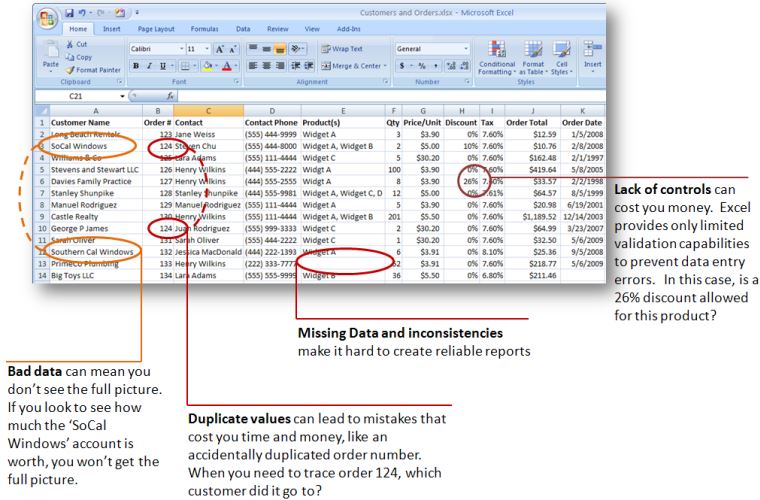
The Solution: Store Related Information Once, Eliminate Redundancy
Relational databases organize related information centrally using structured query language (SQL), allowing you to connect distinct entities without data duplication. Key advantages include:
- Fewer Errors and High Integrity: Maintaining a single normalized record for each user, product, or order eliminates mismatched spellings, orphaned foreign keys, and fractured reporting metrics.
- Superior Concurrency & Performance: Updating a client's status or inventory count in one central database transaction immediately reflects across every dependent web query and application thread.
- Robust Security & Access Control: MySQL offers granular user privilege management, SSL encryption, and authentication protocols, ensuring sensitive operational records are securely managed rather than exposed in unsecured files.
- Actionable Business Insight: Centralized SQL tables make high-speed indexing, complex joins, and executive analytics simple, fast, and reliable.
How Does a MySQL Database Work?
MySQL stores related information together in tables and establishes structured primary-to-foreign-key relationships between them. Whether handling simple user profiles or complex multi-tenant enterprise transactions, MySQL maintains strict ACID (Atomicity, Consistency, Isolation, Durability) compliance.
Data resides in highly optimized Tables (utilizing storage engines like InnoDB with dedicated field types). You can then design responsive Web Forms for frictionless user input and generate high-performance operational Reports.
Ready to take the next step?
Discover when to deploy MySQL across your infrastructure, or download our comprehensive technical guide.
Continue to Page 2: When Should I Use MySQL? »